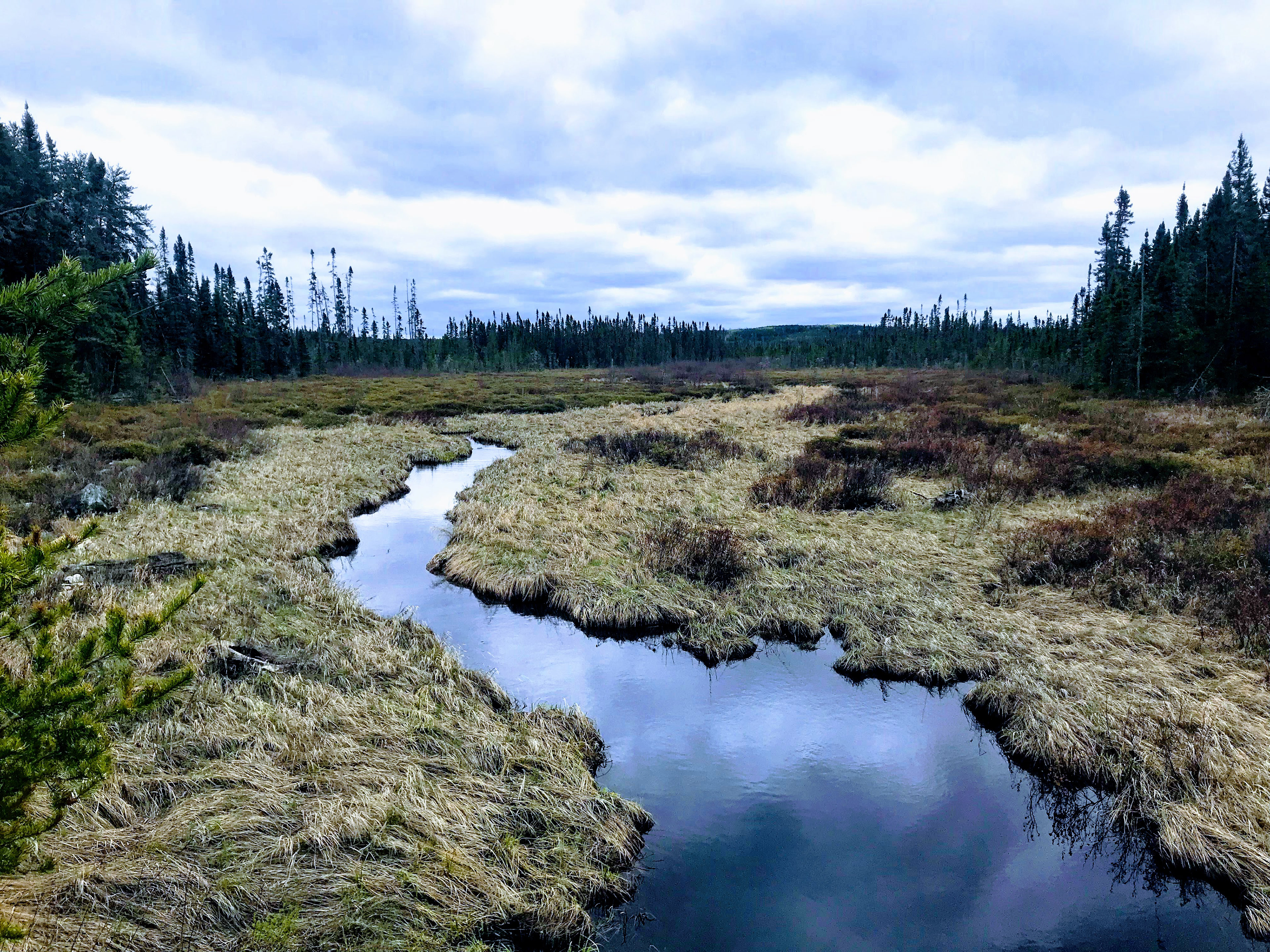
The group has done a lot of research in Canada and around the world to examine processes leading to the formation and degradation of methylmercury, especially in wetlands. Methylmercury is produced by microbes, largely in anoxic environments and is important because it is the primary form of mercury that accumulates in organisms and through diet, in humans. Research approaches are varied and include a mixture of fieldwork, laboratory experimentation and modelling.
For an idea of this kind of work, below are a few recent papers published by our group or in collaboration with colleagues about methylmercury in wetlands and wet soils and sediment:
Syed, M.A.; Melles, S.J.; Smenderovac, E.E.; Huang, H.; Emilson, E.; Mackereth, R.W.; Mitchell, C.P.J. (2026) Evidence of increased mercury methylation in boreal soils following vehicular disturbance by forest harvesting. Forest Ecology and Management, 612, 123701.
Tang, W.; Bai, X.; Zhou, Y.; Sonne, C.; Wu, M.; Shiung Lam, S.; Hintelmann, H.; Mitchell, C.P.J.; Johs, A.; Gu, B.; Nunes, L.; Liu, C.; Feng, N.; Yang, Y.; Rinklebe, J.; Lin, Y.; Chen, L.; Zhang, Y.; Wang, J.; Li, S.; Wu, Q.; Sik Ok, Y.; Xu, D.; Li, H.; Zhang, X.; Ren, H.; Jiang, G.; Chai, Z.; Gao, Y.; Zhao, J.; Zhong, H. (2024) A hidden demethylation pathway removes mercury from rice plants and mitigates mercury flux to food chains. Nature Food, 5, 72-82.
McCarter, C.P.R.; Sebestyen, S.D.; Coleman Wasik, J.K.; Engstrom, D.R.; Kolka, R.K.; Jeremiason, J.D.; Swain, E.B.; Monson, B.A.; Branfireun, B.A.; Balogh, S.J.; Nater, E.A.; Eggert, S.L.; Ning, P.; Mitchell, C.P.J. (2022) Long-term experimental manipulation of atmospheric sulfate deposition to a peatland: response of methylmercury and related solute export in streamwater. Environmental Science & Technology, 56(24), 17615-17625.